"Every time we start a new project, we always ask ourselves the same question: What can we do better and different?" - Ricardo Guadalupe
Source: forbes.com
What's Less Cash Society ?
Bank of Indonesia via its
Governor, Agus D. W. Martowardojo, has officially announced a program which
includes a non-cash national movement or "Gerakan Nasional Non-Tunai
(GNNT) on August 14th, 2016 in Jakarta. This program is aimed to enhance the
awareness of all society, including businessmen/entrepreneurs also government
institutes, to utilize non-cash payment tools while having financial
transactions due to its ease, safety, and efficiency.
In his speech, Agus states that GNNT is introduced in order to increase the awareness of all community to use non-cash instruments, thus, within time, there will be a form of community or society which may prefer to utilizing the instruments for all of their economic activities, which is then called a "less cash society" (LCS). As a commitment to create a broader use of the instruments, Bank of Indonesia declares GNNT as an annual movement which will be supported by numerous activities such as socialization events to acknowledge people more on how to use non-cash instruments for all payments or transactions that they have made.
And for information, following the commitment, Bank of Indonesia has held the socialization events through some roadshows to universities in Banjarmasin, Makassar, Medan, and Semarang from November 1st until December 1st with a theme of "Smart Money Wave".
How do we progress in becoming Less Cash Society ?
In his speech, Agus states that GNNT is introduced in order to increase the awareness of all community to use non-cash instruments, thus, within time, there will be a form of community or society which may prefer to utilizing the instruments for all of their economic activities, which is then called a "less cash society" (LCS). As a commitment to create a broader use of the instruments, Bank of Indonesia declares GNNT as an annual movement which will be supported by numerous activities such as socialization events to acknowledge people more on how to use non-cash instruments for all payments or transactions that they have made.
And for information, following the commitment, Bank of Indonesia has held the socialization events through some roadshows to universities in Banjarmasin, Makassar, Medan, and Semarang from November 1st until December 1st with a theme of "Smart Money Wave".
How do we progress in becoming Less Cash Society ?
Deputy Director for
Department of Payment System Surveillance and Policy, Susiati Dewi, states that
currently GNNT has successfully penetrated 24 cities where total of 1.2 million
people within have been using non-cash instruments for their transactions, e.g.
credit card, debit card, etc. And she adds that this progress is expected to
continue so that in 2024 around a quarter of population in Indonesia have finally
become aware and familiar with GNNT.
In comparison to other ASEAN countries, the utilization of electronic-based payment transactions in Indonesia is considered relatively low. Having consideration to the number of population and the condition of geographic there is a huge potential for the extension of access to the payment system service in Indonesia. Therefore, Bank of Indonesia as the major player in providing service for payment system in Indonesia does need to have a strong commitment to push forward the utilization of non-cash instruments for all transactions to actualize LCS.
In comparison to other ASEAN countries, the utilization of electronic-based payment transactions in Indonesia is considered relatively low. Having consideration to the number of population and the condition of geographic there is a huge potential for the extension of access to the payment system service in Indonesia. Therefore, Bank of Indonesia as the major player in providing service for payment system in Indonesia does need to have a strong commitment to push forward the utilization of non-cash instruments for all transactions to actualize LCS.
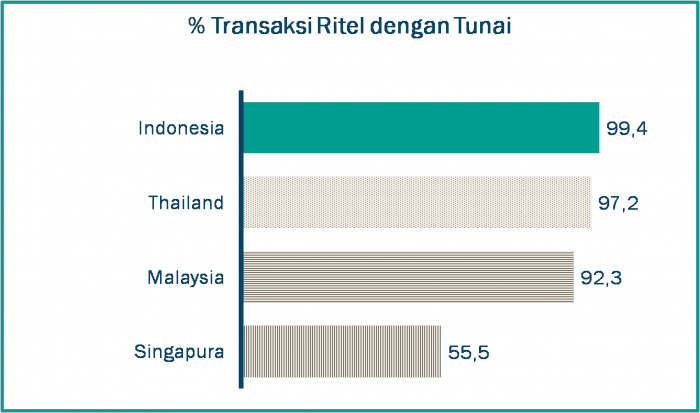
Source: McKinsey
& Company, Asia Pacific Payments Trend, Global Payment Summit 2013
Here is a picture of LRT/MRT ticket valid for use in Singapore (left) and Octopus Card valid for use in Hong Kong (right). This is an example on how people (resident, tourist, etc.) together with the Government in Singapore and Hong Kong have been massively progressing the utilization of non-cash tools or instruments for any transactions. Moreover, those instruments, in the form of cards, are not only used for transportation purpose, but (magically) also for shopping, dining, etc.

Source: private docs
What's the benefit of Less Cash ?
As discussed in many
other articles that there are a lot of benefits which we can take from using
non-cash instruments, such as:
- hassle-free, since we do not have to bring a lot of money whenever we want to make any purchase or transaction. We may only need a credit card, a debit card, or even a smart phone and this may help prevent from robbery or other criminal activities.
- cost-efficiency, since this tools may help reduce the cost for production, distribution, and management of paper-based money.
- automatically-recorded, since every purchase or transaction made is recorded automatically this may help us in calculating our economic activities, including for the purpose of expense planning and controlling. In addition, this benefit may prevent from "underground economy" or illegal economic activity which is commonly held using cash money.
- increase money velocity, since the use of this tool shall increase the money circulation within the economic system and this is expected to eventually stimulate the economic growth.

Source: private docs


